Monday, May 6, 2013

APRIL 24-26: GOOD WEATHER & A STRONG CURRENT TAKE US TO BELHAVEN, NORTH CAROLINA

APRIL 24:  What a difference a day makes.  The day dawned with blue skies and water as smooth as a mirror.   We have a long day's travel today so an early start was mandated. An easy departure for the dock saw us underway just after 7:00 a.m.

The current was in our favor so we clicked along at 10 miles an hour which for our slow boat is like burning rubber!  Today we have to cross Pamlico Sound which we had been warned to do only if the weather is calm as the wind can really kick up the waters.  We crossed in record time and arrived in Belhaven ahead of schedule.
Each bird, sitting on its own piling, enjoying a beautiful sunset in Belhaven

April 25-26:  As Belhaven will be our home for several days, we traveled into the nearby town of Washington to pick up a rental car and do some shopping.  We also arranged to meet up with the former owners of the Duddon Pilot:  John and Dorothy Larson.  The boat was named Dot.com when the Larsons owned the boat.  A nod to Dorothy whose nickname is Dot.
The former and current owners of our trusty Monk 36.
We enjoyed a delightful lunch with John and Dorothy at a restaurant in Belhaven.  They gave us their seal of approval that we have taken good care of the Monk.  We are grateful to them for all the advice and wisdom that they shared with us when we bought the Monk.

APRIL 21-23: BATTLING THE WIND, BRIDGES AND SHOALS

April 21:  The weather improved enough for us to take leave of Wrightsville.  The first obstacle of the day was the Wrightsville Bascule bridge which at an 18 ft vertical draft we cannot clear.  The bridge tender is a stickler for protocol and so we and several other boats had to battle the current (which is particularly strong here) for the scheduled opening which is only on the hour.  Finally, the bridge opened and we proceeded north to our next obstacle on the course:  Figure Eight Island bridge.  

Initially, we thought that we would have to wait for this bridge to open but were pleasantly surprised when the water height marker on the side of the bridge indicated that we could make it through without waiting for the scheduled opening.

We were not so lucky with the third and final bridge of the day.  With only a 12 ft. clearance, we definitely needed a bridge opening.  Unfortunately, while we waited for the scheduled opening (only on the hour) the wind really picked up and the bridge tender informed us that he might not be able to open the bridge at all.  Yikes!!  We idled around waiting for the appointed hour and lady luck was with us.  Even though the wind was gusting at around 25 miles per hour, the bridge tender opened the bridge for us.  We concluded that the several sail boats that were still making their way up would not be so lucky.

Our original plan was to anchor in Mile Hammock Bay which is a small man-made bay and is part of  Camp Lejeune.  This harbor was built during World War II so that the Marines could practice amphibious landings.  Camp Lejeune is an active military training base and maneuvers are still conducted in the Bay.  Given the increasingly strong winds, however, we elected to stop at a small marina prior to Camp Lejeune.  Fortunately, the marina owners were on hand to help us tie up but we found that the depth at the slip was not as advertised and our depth alarm went off when we touched the bottom at less than 4 feet.  We were assured that the bottom was only mud and that we were at low tide.  Translation:  we will only be able to leave at high tide.  

April 22:  The wind howled all night but abated somewhat in the early morning.  We debated whether to try and leave or not.  Eventually, we made the decision to leave as the weather was predicted to deteriorate over the next few days and we did not want to wait out the weather at this location.  The marina owners true to their word arrived at 7:00 a.m. to help us leave.  We definitely could not have left the dock without their assistance as the current and wind were both working against us.  We were able to power our way out of the marina on our second attempt.  

Breathing a sigh of relief, we cruised on by Camp Lejeune to Onslow Bridge which is operated by the military to provide access for the Marines and their heavy armored equipment to cross the Waterway.  We rushed to catch the scheduled opening and the Military Bridge Tender was kind enough to hold the opening until we arrived.   

Things were looking up or so we thought.  One of our cruising guide books stated that there is heavy shoaling at one particular stretch of the Waterway boaters are advised to favor the green marker side.  Which we duly did....until a very loud thud announced that we were well and truly grounded.  The Captain tried to back the boat off the shoal-fortunately all sand and not rock here-but we did not budge.  What to do?  Wait for the tide to rise?  Call Tow Boat US?  We took a deep breath and tried to back off again, very slowly the boat moved a little, we waited and tried again.  This time the boat moved slowly back into the channel and we were able to find deeper water.  So much for following guide books!  If we had stayed in the middle of the channel we would have been in deep water.  Oh well!  The annals of boating state that there are only three types of boaters:  those who have run aground, those that will and those who lie about it.

The engine sounded fine, no vibration, so we proceed on our way to Morehead City.  The wind continued to increase as we crossed Bogue Sound and really picked up steam as we crossed the busy commercial harbor of Morehead City and adjacent Beaufort.  We arrived in the marina and were tied up safely before the wind reached over 30 miles per hour. We were pleased to meet up with our friends on Third Reef and Last Dance here.  

April 23:  Strong winds and thunderstorms dictated that this would be a two night stop.  Food shopping and laundry were also on the agenda.


Saturday, April 20, 2013

APRIL 19-20: STUCK IN WRIGHTSVILLE, NORTH CAROLINA

April 19-20:  A major storm is heading from the west to our area in the next few days so we decided to make a short hop to Wrightsville to ride out the bad weather.  We had some rain en route but with the ebb current with us we made good time into Wrightsville.

An early arrival allowed us to do those unavoidable boat chores of laundry and food provisioning before the deluge arrived.  And it did pour down during the night.  Fortunately, the wind was not too strong so we were lulled to sleep by the music of the rain.

APRIL 16-18: AN ENCOUNTER WITH AN ELEPHANT EN ROUTE TO WILMINGTON, NORTH CAROLINA

April 16:  Today was a transit day on the way to Wilmington, NC.  We made slow progress leaving Georgetown as the current was against us.  Additionally, we stopped en route at Osprey Marina as we were told that they have the lowest prices for diesel fuel.  That was the case and we purchased fuel at the best price since 2011.  After a slow 50 mile run, we decided to stop at Barefoot Landing in North Myrtle Beach. Just your basic tie up with not much of interest in the surrounding attractions.

April 17-18:  Wilmington, North Carolina:  We left our luxurious accommodations as soon as possible and headed for the "Rock Pile".  This is a stretch of the ICW that was cut through limestone.  The rock is between 65-144 million years old and is not kind to boat hulls.  We had heard horror stories about this section of the ICW but concluded that paying attention and staying in the middle of the channel would see one safely thorough.

After waiting for the Little River bridge to open for us, we crossed into North Carolina and made our way across several shallow inlets to the entrance of the Cape Fear River.  Here we departed the ICW to make the 15 mile trip up the river to Wilmington.  The Cape Fear River derives its fearsome name from the terror of pirates to the numerous scuttling of ships during the Civil War.  Here also the Atlantic Ocean rolls into the Cape with considerable force.

 Crossing into North Carolina
 Boat and restaurant not doing too well along the ICW.

As we proceeded along the ICW, we could not believe our eyes.  What looked like an elephant from a distance was one!  We spent several minutes at idle speed taking photographs of these children who were swimming and playing with an elephant.  We needed the following photographic evidence as no one would believe us otherwise. Both the elephant and the children were having a great time.  The elephant allowed the children to climb on its back and it squirted water at them.  What a hoot.  We were tempted to join in but had to press on.


 Entrance to downtown Wilmington.
We docked in front of this cruise ship at the city docks which are a stone's throw from the historic downtown. 
The Battleship USS North Carolina.   Commissioned in 1941, it earned the name "Showboat" as it earned 15 battle stars during World War II.  
 The US Post Office-a classic Revival style building.
 We thoroughly enjoyed our stay in Wilmington especially the great bistro restaurant where we had supper.  Wilmington is a side trip off the Loop but well worth a visit.
 Railway museum

APRIL 14-15: GEORGETOWN, SOUTH CAROLINA

April 14-15: After a 51 mile run, we arrived in Georgetown where we will stay for two nights.  Georgetown is the third oldest city in South Carolina.  The city leaders have a down a good job in preserving and restoring the place.  The town was once a major port exporting rice and indigo around the world.  We toured the rice museum which covers the story of the rice culture that dominated this area and took a walking tour around this pleasant town.

 Town clock is the focal point of the historic district.
 More lovely live oaks.
 A thriving main street with numerous specialty shops and restaurants.
 City Hall
 The bones of the Brown's Ferry Vessel that was discovered near Georgetown.  It is the oldest vessel of colonial manufacture in the US that has been recovered.
 Model of the Brown's Ferry.
The Captain wishing he could have a pizza baking oven like this one.

APRIL 13: LEAVING BEAUFORT, SOUTH CAROLINA

April 13:  Good weather today allowed us to make an early start from Beaufort as we plan to cover 82 miles today.  Our overnight stop is an anchorage north of Charleston.  We are skipping Charleston this time around as we spent time there on a previous visit.  It is a great city and hopefully we will visit it again in the future.

The most exciting part of the trip was traversing Elliot Cut.  The Cut is a short and narrow passage where the current can run up to 6.5 knots at maximum ebb.  Boats are advised to announce their intention to cross before proceeding through the Cut.  It is a good thing that we followed this procedure as a 220 foot cruise ship was approaching the Cut from the northern end.  The Captain acknowledged us and agreed to wait for us to exit the Cut.  Fortunately for us, the current was going with us and we had a wild ride through the Cut doing 11 knots.  When we came out at the other end, we were extremely thankful that we did not meet the cruise ship in the Cut.

The wind picked up as we crossed Charleston Harbor and meandered our way back onto the ICW to head for our anchorage.

 Charleston Harbor


 Leaving Charleston Harbor

We anchored in Long Creek a short distance from the ICW.  We were the only boat there and enjoyed a beautiful sunset and a peaceful night.

APRIL 10-12: BEAUFORT, SOUTH CAROLINA

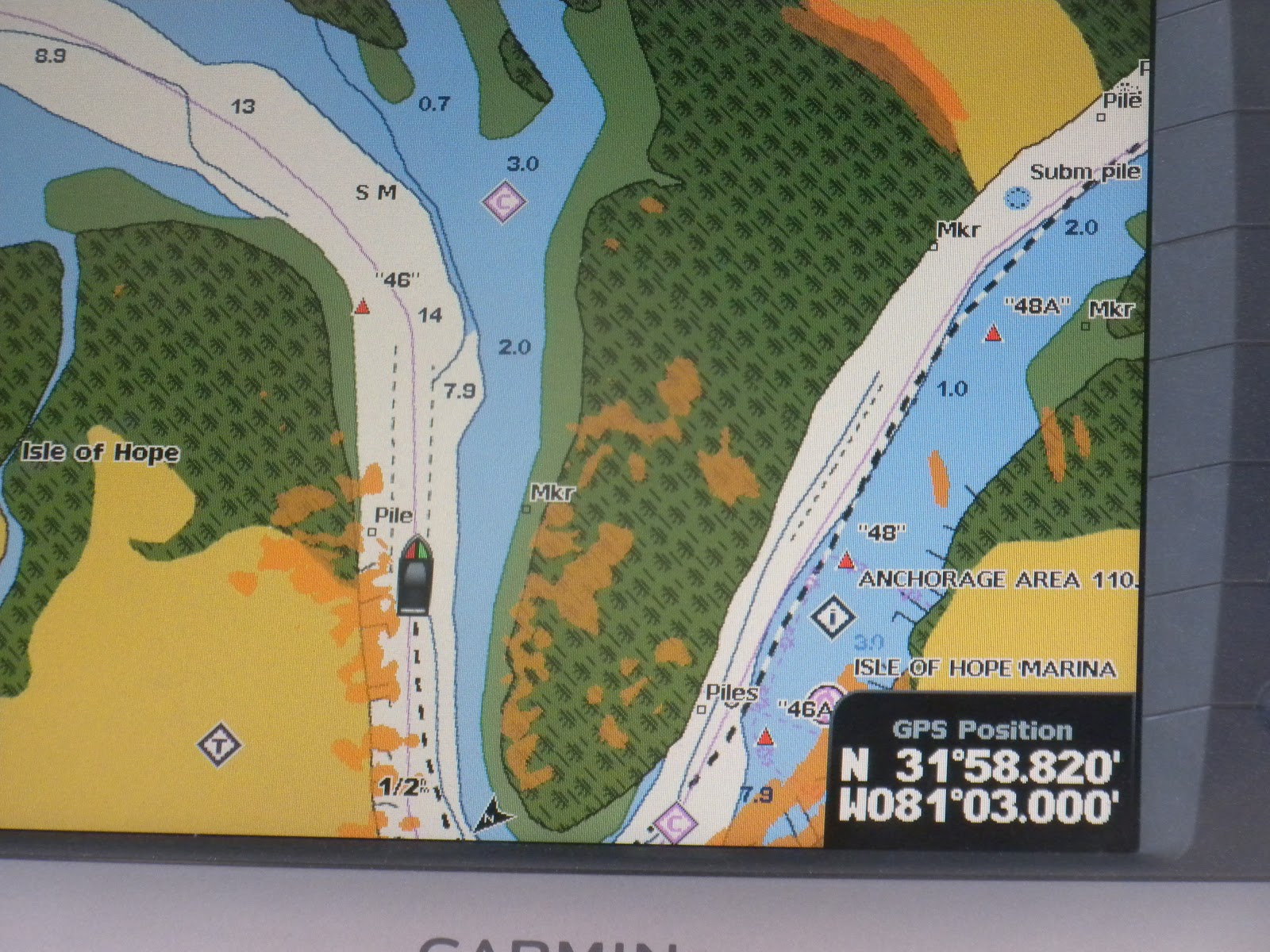
April 10:  Time to leave Savannah.  Our destination today is Beaufort, South Carolina.   A 67 mile run which for us means a long day so again we were up and ready to depart as soon as the sun rose.  Savannah is close to the border with South Carolina so we crossed into new territory.  Below is a GPS shot of how the Inter Coastal Water (ICW) winds its way through the low countryside of South Carolina.

The weather is predicted to be unsettled for the next two days so we elected to spend three nights in Beaufort.  We played tourist on the first day as rain was promised for the morrow.  Beaufort is a quaint town that has retained much of its Antebellum architecture.  The following are examples that have survived the Civil War, hurricanes and several widespread fires.


 Beautiful, old live oaks dot the town.
 I think the Captain has found a new first mate!